
Dvloper is entering Phase 3 of a strategic AI collaboration with a Fortune 10 infrastructure leader, evolving an enterprise assistant into a more advanced agentic system designed to reason across complex internal knowledge and support real operational workflows in production environments.
Enterprise AI rarely fails during training. It fails in production.
That reality has shaped our collaboration with a Fortune 10 infrastructure leader, where the goal was never to build another impressive assistant, but a system capable of navigating complex internal knowledge and supporting real operational workflows.
After successfully delivering Phase 1 and Phase 2, we are now entering Phase 3 - the biggest stage of the partnership so far.
From Early Validation To Deeper Operational Value
The earlier phases of this collaboration were centered on building the right foundation: understanding the problem space, shaping the assistant architecture, integrating knowledge sources, and validating how AI could be applied in a way that was actually useful inside a real enterprise environment.
That part matters more than people think.
In enterprise settings, AI is not valuable just because it can answer questions. It becomes valuable when it can work within complex systems, reason through fragmented information, and produce outputs that are relevant, reliable, and aligned with how teams actually operate.
That is exactly where this collaboration has been heading.
With the first two phases successfully completed, with great feedback from the stakeholders of going beyond the initial scope - the project is now moving post foundational capability and into a more advanced stage focused on broader reasoning, stronger orchestration, and deeper operational fit.
What Phase 3 Is About
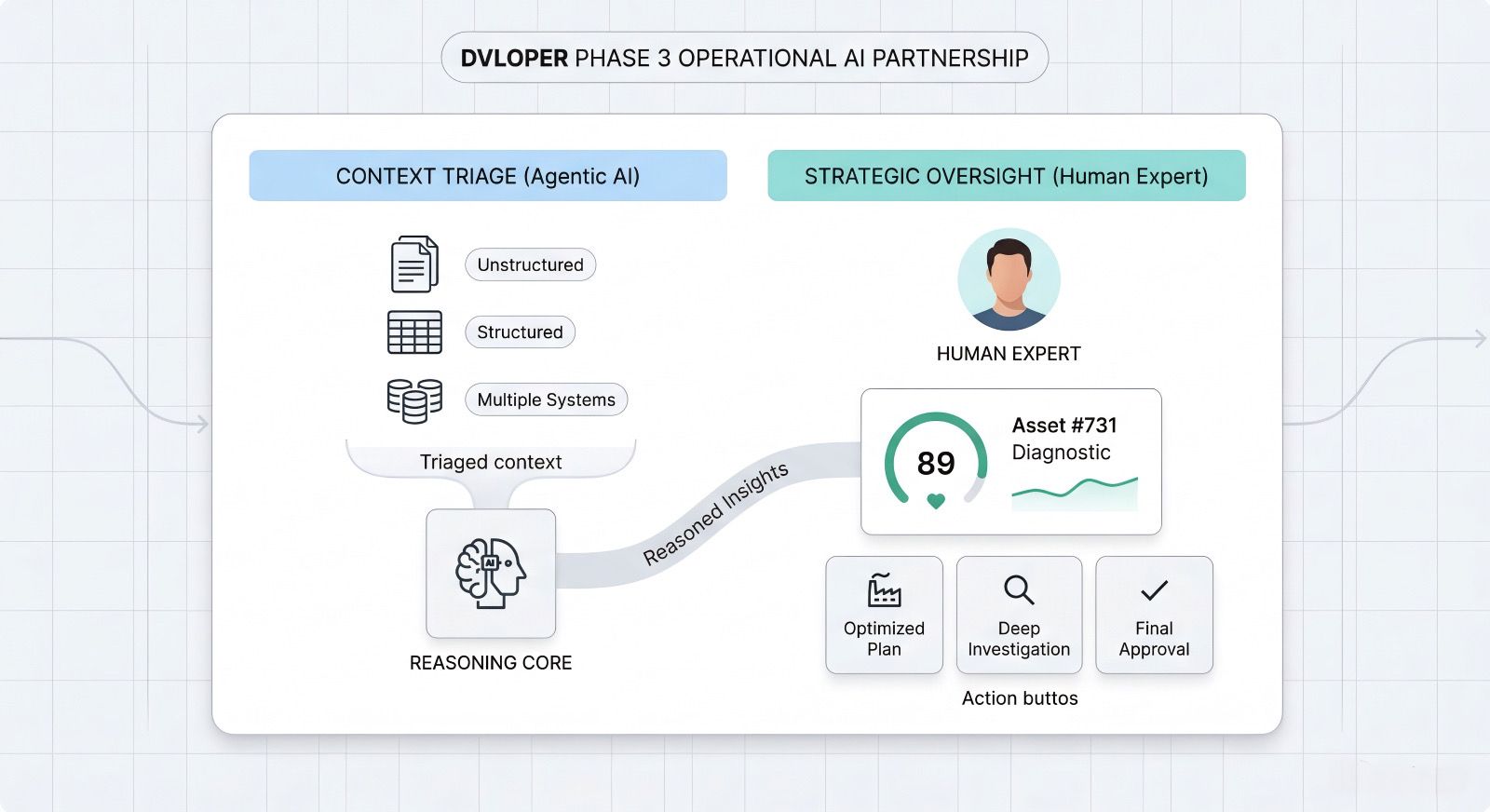
This next stage focuses on expanding the agentic capabilities of the platform so that it can do more than respond, it becomes a proactive agentic framework instead of a reactive agentic mechanism. It needs to reason across enterprise context, coordinate specialized workflows, and support more structured decision paths in environments where accuracy and traceability matter.
At a high level, this phase builds on the progress already made in areas such as:
- Agent orchestration for more structured task handling
- Context aware reasoning across multiple internal knowledge sources
- Improved routing between specialized flows and capabilities
- Stronger support for complex operational investigations
- A more production minded approach to integration, validation, and rollout
The goal is not to build AI for the sake of AI.
The goal is to build a system that can genuinely support teams operating in complex technical environments, where the volume of information is high, the paths to resolution are rarely linear, and trust in the output matters just as much as speed.
Why This Work Matters
A lot of AI content today focuses on generic assistants and surface level automation. But enterprise reality is different.
Real internal systems are layered. Knowledge is distributed. Processes evolve over time. And the people using these tools are not looking for novelty; they are looking for practical value in their day to day workflows.
That is why this collaboration has been shaped around a more grounded engineering approach.
Instead of treating the assistant like a standalone chatbot, the system has been designed as a more structured, agent driven capability: one that can connect to enterprise knowledge, follow defined reasoning paths, and support users in a way that feels closer to an operational companion than a generic interface.
That distinction is important, especially in larger organizations where adoption depends on whether the solution can fit into real workflows, not just perform well in a controlled demo.
In most large organizations, operational teams deal with high volumes of structured and unstructured information coming from multiple systems that were never designed to talk to each other. The people doing the work are experienced - they know how to navigate the complexity - but they spend a disproportionate amount of time on the repetitive cognitive work: gathering context, cross-referencing sources, triaging what matters from what doesn't. That is not an automation problem. It is a reasoning problem. And that is where agentic AI actually starts to make sense - not as a replacement for expertise, but as a layer that handles the heavy lifting before a decision needs to be made.
What Makes This Phase Different
What makes Phase 3 significant is not only the scale of the work, but the level of maturity behind it.
By this point, the collaboration is no longer about testing whether the idea has potential. That has already been demonstrated through the earlier phases. Phase 3 is about extending that success into a larger, more capable system with stronger real world value.
For our team, this is also the kind of work we care deeply about: combining modern AI frameworks with disciplined engineering, thoughtful architecture, and a strong understanding of how enterprise systems actually behave.
It is one thing to prototype an assistant.
It is another to design one that can evolve responsibly inside a large operational environment.
That is the challenge and the opportunity in front of us now.
Looking Ahead
We are excited to begin Phase 3 and continue building on the trust, momentum, and technical foundation established so far.
This next chapter represents more than just another milestone. It reflects the strength of a partnership built through delivery, iteration, and a shared commitment to building AI systems that are useful, reliable, and grounded in real operational needs.
For Dvloper, it is also a strong example of how we approach enterprise AI, not as a trend, but as an engineering discipline.
The companies that will lead with AI are not the ones moving fastest. They are the ones building systems that their teams actually trust.